
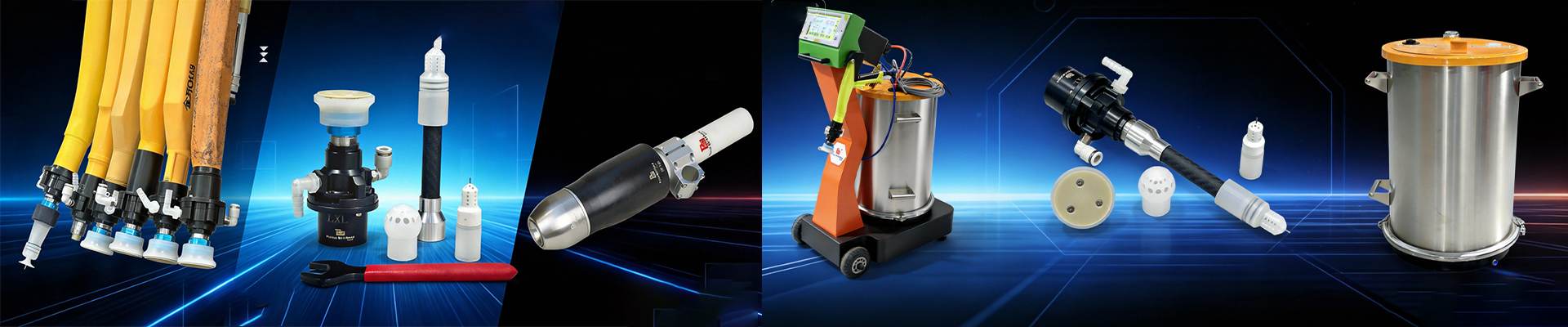
Small Rotary Cup, Big Impact — A New Revolution in Powder Coating
For decades, electrostatic powder coating relied on the same fundamental approach: a corona discharge gun generates a high-voltage electrostatic field, charged powder particles travel toward the grounded workpiece, and the coating builds up on the surface. The technology worked. But it also carried limitations that the industry largely accepted as unavoidable — uneven coverage on complex geometry, Faraday cage problems in recessed areas, high powder waste, and inconsistent film thickness on mixed production runs.
The introduction of compact rotary cup atomization technology has changed that calculus. What was once an expensive, large-scale industrial process has become accessible for small and medium finishing operations — and the performance difference over conventional corona guns is not incremental. It is structural.
What Makes Rotary Cup Atomization Different
A conventional powder coating gun relies on compressed air to carry powder through the gun body and toward the workpiece. The electrostatic charge is applied as the powder exits the gun, and transfer efficiency depends heavily on the balance between airflow velocity, electrostatic field strength, and the geometry of the target surface.
The rotary cup works on a completely different principle. Powder enters a high-speed rotating cup — spinning at approximately 2,000 RPM — and centrifugal force distributes it evenly across the cup surface before ejecting it as a fine, uniformly charged mist. There is no compressed air propulsion. The powder leaves the cup edge with consistent particle size, charge distribution, and velocity — and because airflow turbulence is eliminated, the particles follow electrostatic field lines more precisely.
The practical result is better coverage on every surface type: flat panels, tube sections, welded assemblies, and complex parts with internal corners and recessed geometry.
Why Particle Size Consistency Matters
One of the less-discussed advantages of rotary atomization is particle size uniformity. In conventional pneumatic guns, powder particle size distribution varies with airflow fluctuations, powder feed rate changes, and gun wear. Larger particles deposit unevenly; smaller particles may not adhere properly or may be lost to booth exhaust.
Rotary cup atomization produces a significantly narrower particle size distribution. This translates directly into:
- More uniform film thickness across the entire workpiece surface
- Reduced orange peel texture on flat sections
- Lower powder consumption per square meter of coated surface
- More predictable curing results, since uniform film thickness cures more evenly
Overcoming the Faraday Cage Effect
The Faraday cage effect remains one of the most persistent technical challenges in powder coating. When electrostatic field lines concentrate on exposed outer surfaces, recessed areas — internal corners, channel sections, enclosed tube interiors — receive little or no powder deposition. Conventional guns can partially compensate through voltage reduction and technique adjustments, but these measures have limits.
Rotary cup atomization addresses the Faraday cage effect through two mechanisms. First, the elimination of turbulent airflow means powder particles are not blown away from recessed surfaces before they can deposit. Second, the fine, uniformly charged particles produced by centrifugal atomization respond more precisely to electrostatic field lines, allowing them to follow contours into areas that coarser pneumatic spray cannot reach.
For a detailed technical explanation, see: How a Rotary Powder Coating Head Helps Improve Coating in Faraday Cage Areas
Accessibility: From Large-Scale to Small Operation
Rotary bell atomization has been used in automotive OEM paint shops for decades — large, fixed, automated systems running high volumes of identical parts. What has changed is the availability of compact, handheld rotary cup technology designed for manual operation and mixed production environments.
A handheld rotary cup gun can be used anywhere a conventional gun is used, on the same hanger systems and in the same booths, without changes to infrastructure. The operator learns a slightly different technique — the gun is held closer to the workpiece, and the spray pattern is different — but the transition is manageable within a normal working week.
Workpiece Memory and Process Consistency
Modern compact rotary cup systems address parameter consistency through programmable workpiece memory modes. The QXD rotary cup system supports 26 preset process configurations (P0–P25) covering flat parts, groove geometry, frame sections, and complex assemblies. Switching between configurations takes seconds, and the settings are consistent across every shift and every operator.
What This Means for Your Operation
The transition from conventional corona guns to rotary cup atomization is about solving specific, recurring problems: Faraday cage coverage failures, inconsistent film thickness on complex geometry, high powder waste on difficult parts, and rework rates that add cost without adding value.
The compact rotary cup makes these problems solvable at the scale of a small or medium finishing operation — without large capital investment, without changes to booth infrastructure, and without the production volumes that large automated systems require to justify their cost.